
What happens to your practice phones, alarm and card machine on 31 January 2027?
By Ben Long, Long Communications
Key points
- The UK's old copper telephone network is being switched off by 31 January 2027.
- Research by Zen Internet found only 18% of small businesses and 26% of large businesses had a replacement in place.
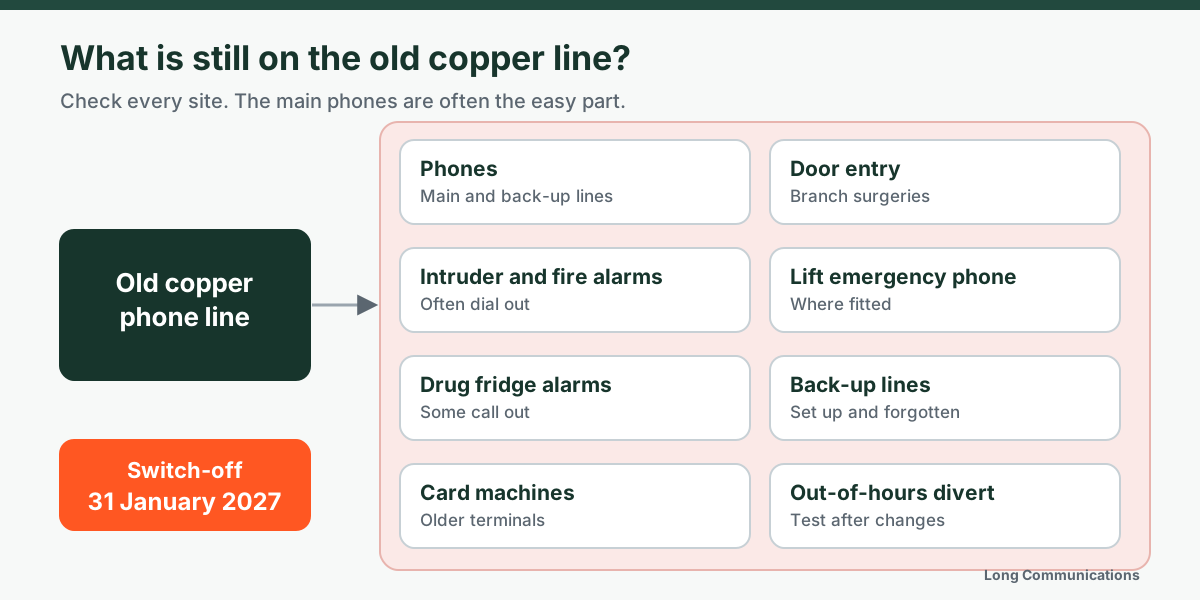
- For vet practices, the risk is less the main phones than alarms, card machines, door entry, lift phones and back-up lines still on copper.
- Moving early avoids the last-minute rush and gives a chance to fix call handling at the same time.
Most vet practices assume the copper switch-off is a phone company's problem. Often the phones are fine. It's the alarm, the card machine and the line nobody remembers that cause trouble.
What is happening
The UK's old copper telephone network is being switched off by 31 January 2027. Every service that still relies on it has to move to a digital, internet-based line before then, or it stops working.
Research by Zen Internet found that only 18% of small businesses and 26% of large businesses had a replacement solution in place. Around one in ten weren't aware the switch-off was happening at all.
Why vet practices are more exposed than most
A typical practice has more connected equipment than a typical office. Some of it was installed years ago and plugged into a phone socket that nobody thinks about now.
Check each of these:
| Equipment | Why it matters |
|---|---|
| Intruder and fire alarms | Controlled drugs and out-of-hours security depend on them |
| Drug fridge and freezer alarms | Some dial out over a phone line when the temperature changes |
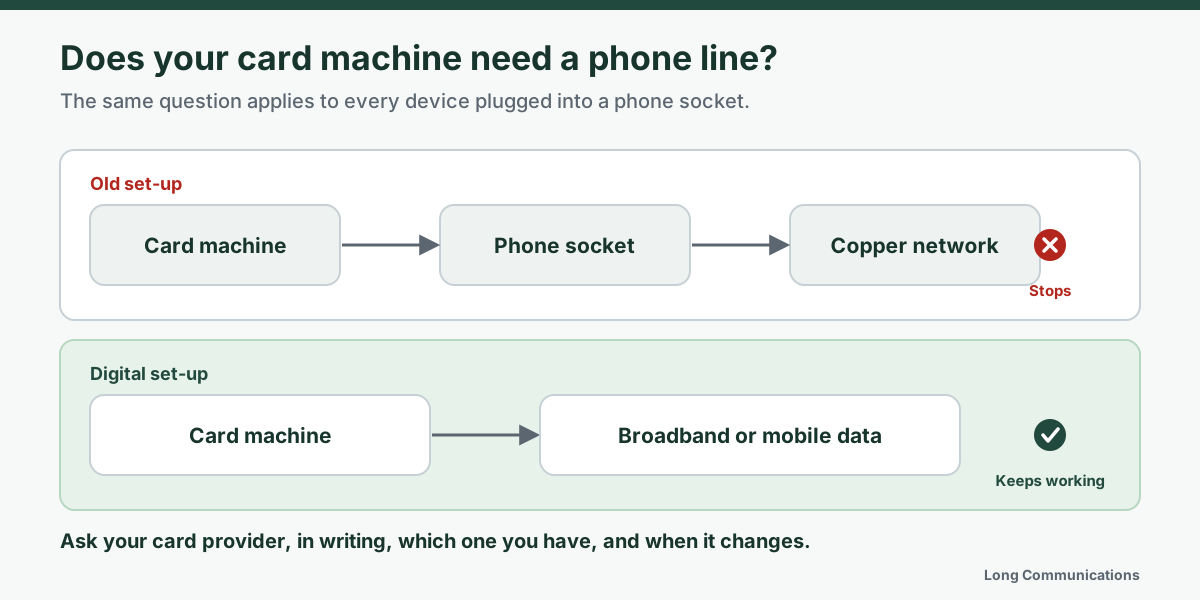
| Card payment machines | Older terminals may still use a phone line |
| Door entry and intercom | Common at branch surgeries and after-hours entrances |
| Lift emergency phones | Required where there is a lift |
| Back-up or "emergency" lines | Often set up years ago as a fallback and forgotten |
| Fax and old analogue lines | Sometimes still used for lab or referral paperwork |
| Out-of-hours divert | Some diverts are set up on the old line itself |
The quiet risk: your out-of-hours divert
If your out-of-hours calls divert from a copper line to a provider or an on-call mobile, test that the divert still works after any change. A broken divert means a client with an emergency hears nothing at 2am. The Royal College requires you to tell clients how to reach out-of-hours care, so this is a compliance question as well as a service one.
Use the switch-off as a chance to fix call handling
Moving lines is disruptive anyway. Doing it once, properly, is better than doing it twice:
- Add a call-back option at busy times instead of an engaged tone.
- Give emergencies their own option at the start of the call.
- Share calls between sites if you have more than one.
- Turn on missed-call reporting so you can see what you are losing.
- Link the phones to your practice system so reception sees who is calling.
What this means for your phones
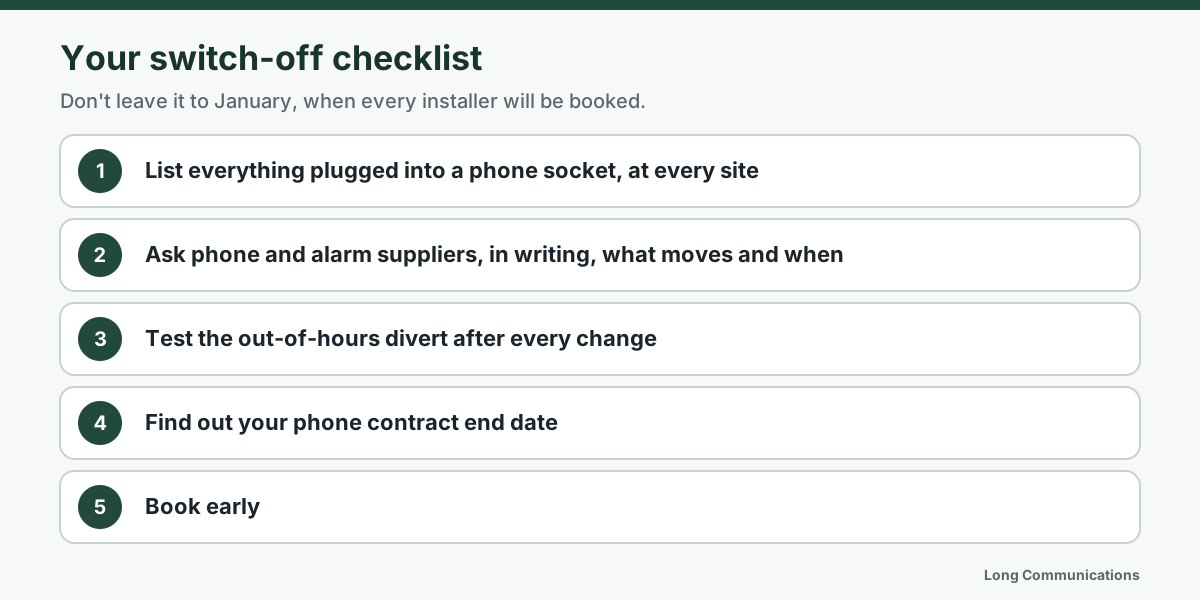
- List everything plugged into a phone socket, at every site.
- Ask your phone and alarm suppliers, in writing, what moves and when.
- Test the out-of-hours divert after every change.
- Find out your phone contract end date; it affects your options.
- Don't leave it to January, when every installer will be booked.
How does your practice compare?
The "Your practice system and communications" section of my check asks about copper lines, contracts and who controls your messages. It takes about two minutes.
This article is a plain-English summary. Check dates and details with your own suppliers.
It takes about two minutes.
Frequently asked questions
- When is the UK landline switch-off?
- The old copper telephone network is due to be switched off by 31 January 2027. After that, services that rely on it stop working unless moved to a digital line.
- What in a vet practice might still use a copper line?
- Intruder and fire alarms, card payment machines, door entry systems, lift emergency phones, fax lines, drug fridge or freezer alarms and back-up phone lines are the usual suspects.
- Do vet practices need new phones for the switch-off?
- Not always. Many practices already use internet-based phone systems. The switch-off is a good moment to check everything else connected to old lines, and to review how calls are handled.
- Will I keep my practice phone number?
- Usually yes. Numbers can normally be moved to a new provider. Check with your supplier before the switch-off rather than after.