
The out-of-hours hand-over: a rule, not just good service
By Ben Long, Long Communications
Key points
- The Royal College requires vets to provide 24-hour cover for animals under their care, or arrange it in advance in writing with another provider.
- Clients must be given the out-of-hours phone number, location, hours and type of service.
- The average UK out-of-hours emergency consultation costs about £276, before treatment.
- Automatic diverts, clear messages and no personal mobiles make the hand-over reliable.
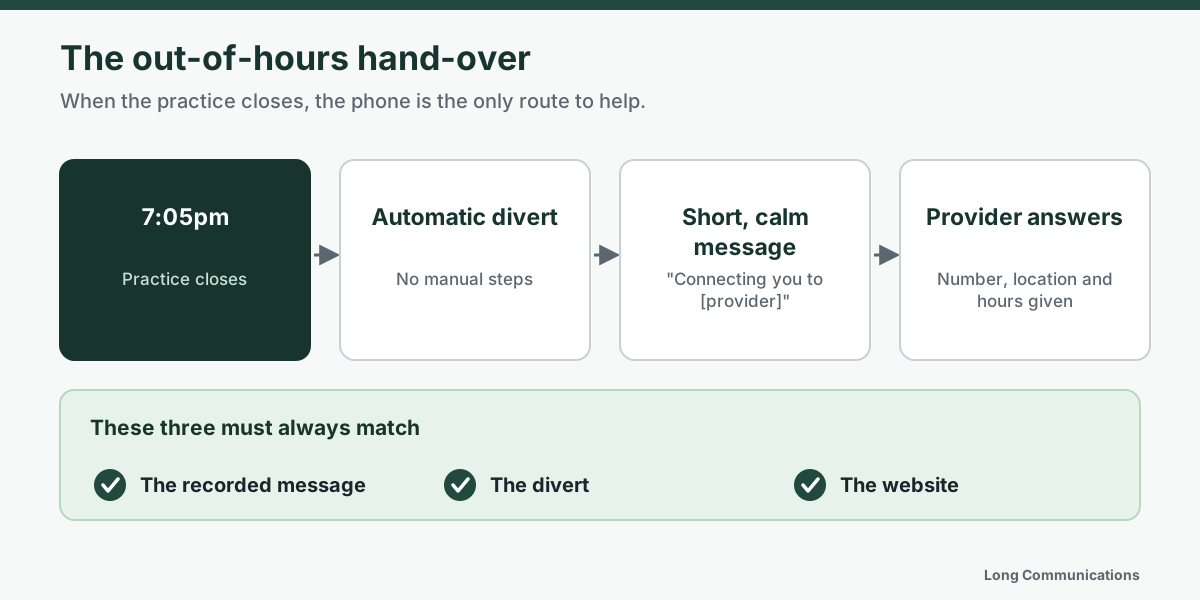
At 7:05pm the practice closes. At 7:20pm a client's dog collapses. What happens next depends entirely on what they hear when they ring.
What the rules say
The Royal College of Veterinary Surgeons requires vets to be able to physically examine animals under their care around the clock, or to arrange this with another provider. That arrangement must be made in advance and confirmed in writing; it isn't enough for the client to be registered somewhere else.
Clients must be given full details: the phone number, location, when the service is available and what kind of service it is.
The Competition and Markets Authority has added that out-of-hours contracts between practices and providers can't have notice periods longer than 12 months, which makes switching provider easier.
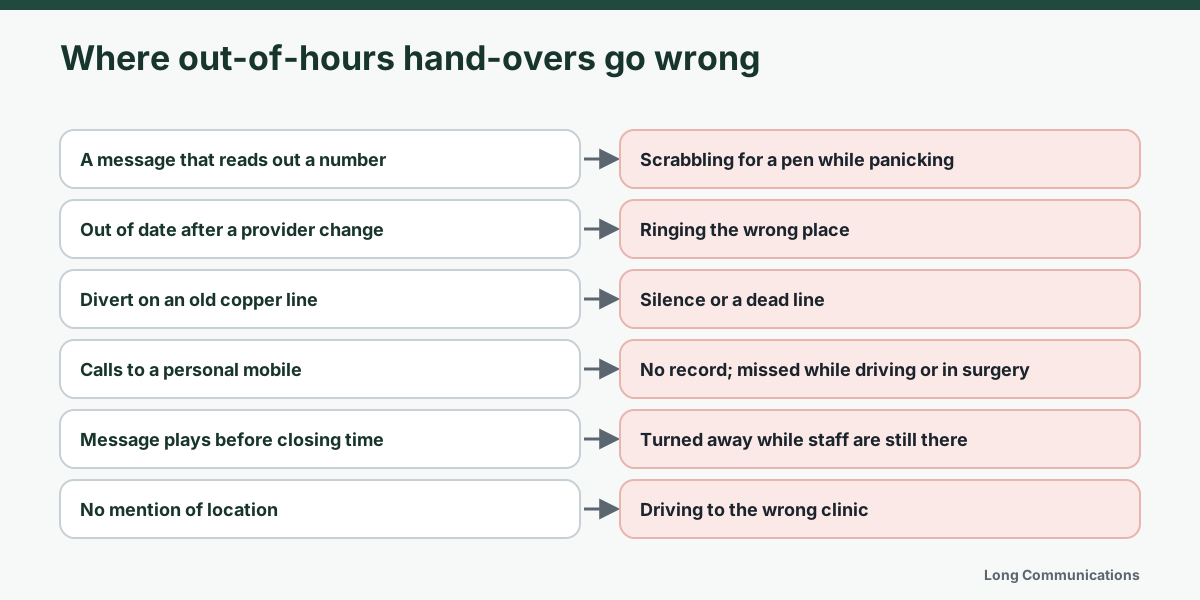
Where hand-overs go wrong
| Problem | What the client experiences |
|---|---|
| Recorded message reads out a number | Scrabbling for a pen while panicking |
| Out-of-date message after a provider change | Ringing the wrong place |
| Divert set up on an old copper line | Silence or a dead line after the switch-off |
| Calls go to the on-call vet's personal mobile | No record, missed calls while driving or in surgery |
| Message plays before closing time | Clients turned away while staff are still there |
| No mention of location | Driving to the wrong clinic |
Each of these is a poor experience. Under the 24-hour rule, it can also become a compliance question.
The money involved
Out-of-hours care is expensive for clients. A January 2026 survey of 49 UK emergency vets found an average of £275.72 for the night-time consultation alone, before treatment; £256.64 in the North.
For practices that run their own out-of-hours, every emergency call that goes elsewhere is lost income. For practices that use a provider, a confusing hand-over is a client experience problem that reflects on the practice.
What a good hand-over looks like
- Automatic divert to the out-of-hours provider or on-call system at closing time, with no manual steps.
- A short, calm message before the divert: "If your pet needs urgent care, you're being connected to [provider] at [location]."
- The details on the website, matching the message exactly.
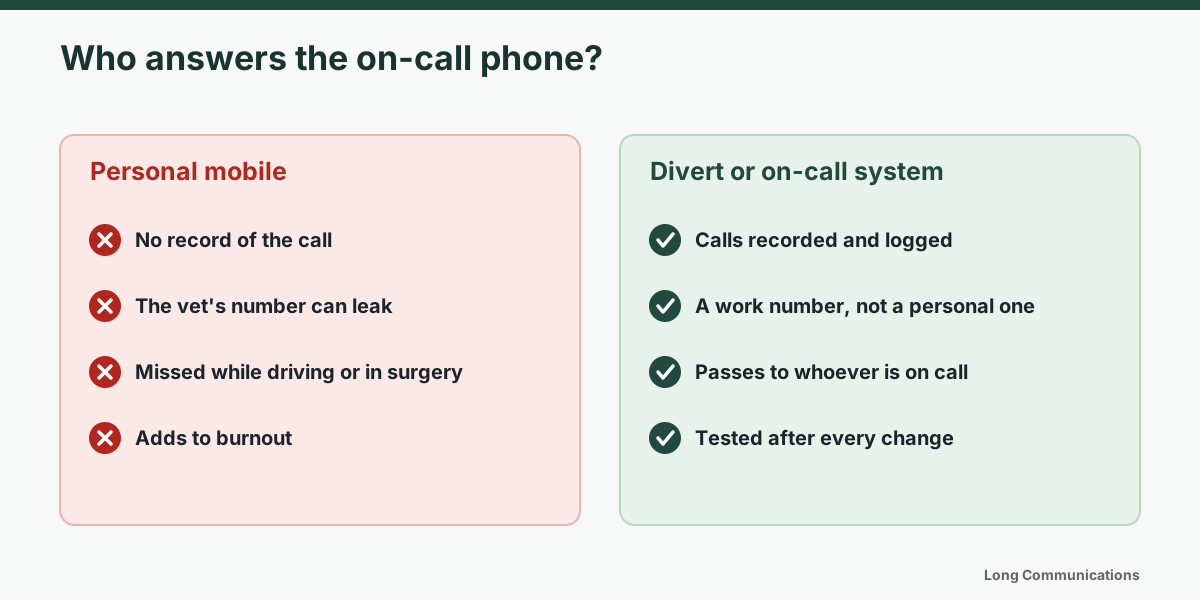
- No personal mobiles. Use an on-call app or system that records and logs calls.
- A test after every change: new provider, new phone system, holiday hours, line move.
- A gentle route for grief calls, such as euthanasia or bereavement, so they never sit in a queue or menu.
What this means for your phones
- Ring your own practice after closing time and listen to what clients hear.
- Check the message, divert and website all match.
- Remove personal mobiles from the on-call route.
- Add the out-of-hours divert to your copper switch-off checklist.
How does your practice compare?
The emergencies and out-of-hours section of my check takes about two minutes.
This article is a plain-English summary, not legal advice. Check the detail with your professional body.
It takes about two minutes.
Frequently asked questions
- Do vet practices have to provide out-of-hours cover?
- Yes. The Royal College requires vets to be able to examine animals under their care 24 hours a day, or to arrange this in advance, in writing, with another provider. Clients must be told the details.
- What must vets tell clients about out-of-hours care?
- The phone number, location, when the service is available and the nature of the service.
- How much does an out-of-hours emergency vet cost?
- A January 2026 survey of 49 UK emergency vets found an average of £275.72 for the night-time consultation alone, before any treatment.
- Should vets use personal mobiles for on-call?
- It's common but risky: calls aren't recorded or logged, the vet's number can leak, and it adds to burnout. A proper divert or on-call app is better.